
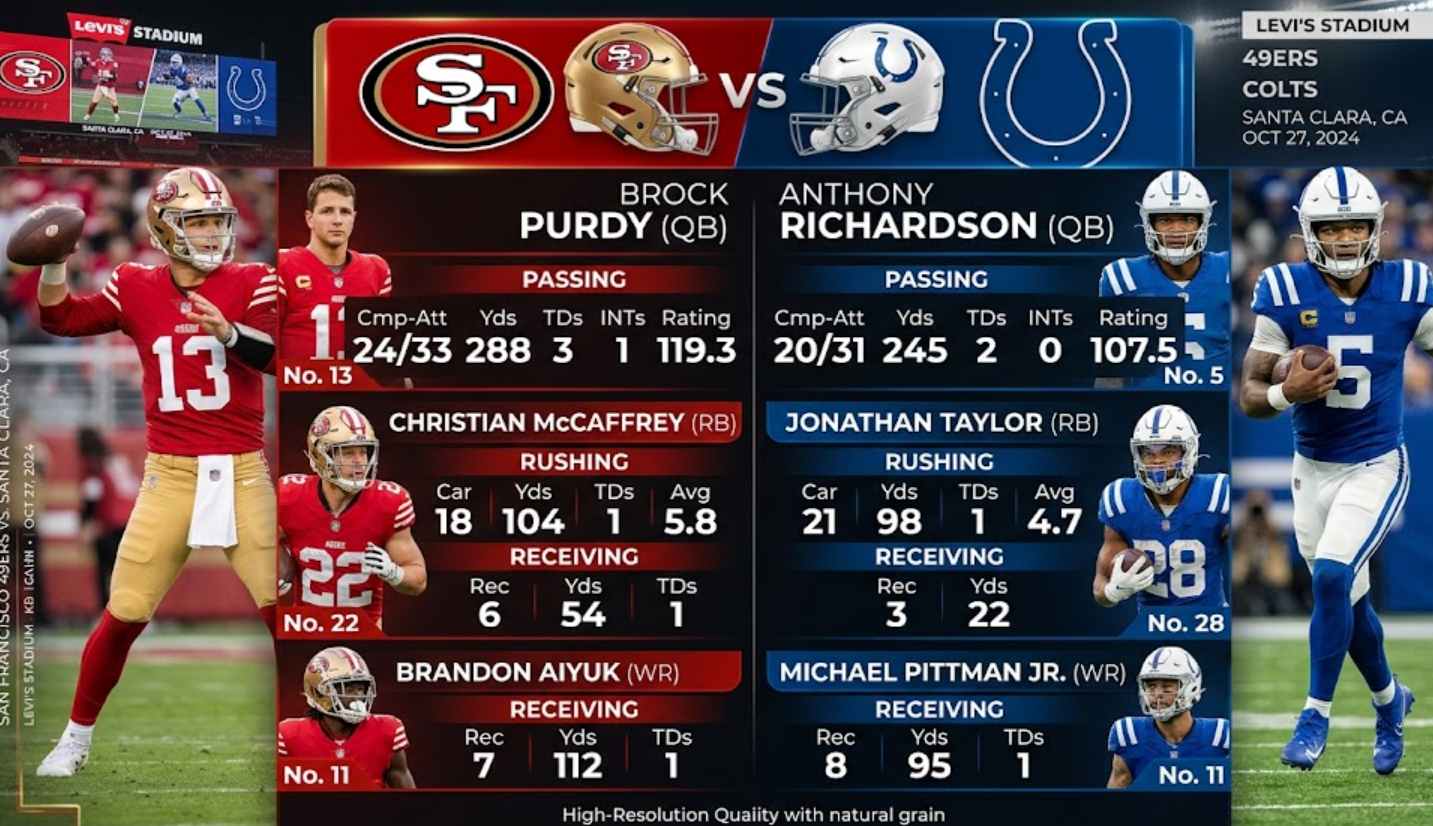
Player statistics play a crucial role in understanding the deeper dynamics of any NFL game, especially in matchups like the 49ers vs Colts match player stats. While the final score tells you who won, it doesn’t explain how the game unfolded, which players made the biggest impact, or which strategic decisions shaped the outcome. By analyzing stats such as passing efficiency, rushing yards, defensive pressure, and turnover differential, you gain a clearer picture of each team’s strengths and weaknesses. In matchups between the 49ers and Colts, these numbers often highlight contrasting playing styles—San Francisco’s structured, balanced approach versus Indianapolis’ adaptability and reliance on key playmakers. This statistical insight not only helps fans better appreciate the game but also provides valuable context for analysts, coaches, and bettors looking to understand performance beyond the scoreboard.
Offensive Performance Breakdown: Quarterbacks and Skill Players
The 49ers vs colts match player stats on offense often highlight how each team approaches scoring and ball movement. Quarterback play is usually the centerpiece, where metrics like completion percentage, yards per attempt, touchdown passes, and interceptions reveal efficiency and decision-making. The 49ers typically benefit from a system that supports the quarterback with a strong run game and high-percentage passing schemes, leading to consistent, controlled drives. On the other hand, the Colts’ offensive output can fluctuate depending on protection and receiver separation, which directly impacts passing accuracy and sack totals. Skill players such as running backs and wide receivers further shape these numbers, with San Francisco often spreading touches across multiple backs, while Indianapolis tends to rely on a primary rusher and a leading receiver to drive production. This contrast creates different statistical profiles that influence time of possession, red zone efficiency, and overall offensive rhythm.
Defensive Impact: Tackles, Sacks, and Turnovers
Defense plays a defining role in shaping the 49ers vs colts match player stats, especially when examining how tackles, sacks, and turnovers influence momentum. The 49ers are traditionally known for aggressive defensive play, generating pressure through strong pass rushes that lead to sacks and hurried throws. This pressure often results in forced turnovers, such as interceptions or fumbles, which can quickly shift the game’s direction. Meanwhile, the Colts rely on disciplined tackling and structured defensive schemes, aiming to limit big plays and maintain field position. Key defensive statistics like third-down stops, quarterback pressures, and forced turnovers help explain which team controlled key moments of the game. When one defense dominates these categories, it often reflects directly in the final outcome, even if the scoreboard alone doesn’t fully capture the intensity of defensive performance.
Key Player Comparisons: Standout Performers from Both Teams
When reviewing the 49ers vs colts match player stats, comparing standout performers from each team helps highlight the individuals who truly influenced the game. These comparisons often focus on quarterbacks, top running backs, leading receivers, and defensive leaders, allowing fans to see who outperformed expectations and who struggled under pressure. For example, a 49ers skill player might shine with efficient yardage and multiple touchdowns, while a Colts counterpart could stand out through high-target volume and clutch receptions. On defense, key players are often evaluated through tackles, sacks, and pass deflections, which show their ability to disrupt the opposing offense. By placing these performances side by side, it becomes easier to understand not just who played well, but how each player’s contribution stacked up against their direct opponent, revealing the competitive balance within the matchup.
Advanced Stats and What They Reveal
Advanced metrics in the 49ers vs colts match player stats provide a deeper layer of insight that goes beyond traditional box score numbers. Stats like Expected Points Added (EPA), success rate, quarterback rating under pressure, and yards after catch (YAC) help explain how efficiently players performed in specific situations. For instance, a quarterback with a modest yard total but a high EPA may have made highly impactful plays at critical moments, even if those plays didn’t accumulate massive yardage. Similarly, receivers with high YAC demonstrate their ability to extend plays and gain extra yardage after the catch, which is often a key factor in sustaining drives. These advanced statistics allow analysts to evaluate consistency, situational effectiveness, and overall contribution to team success, offering a more nuanced understanding of the game.
Another important aspect of advanced stats is how they highlight hidden strengths and weaknesses in both teams. The 49ers may excel in metrics like play-action efficiency and yards per play, reflecting their well-structured offensive system. Meanwhile, the Colts might perform better in defensive efficiency or red zone stop rate, indicating strong situational defense. These insights are particularly valuable when evaluating matchups over time, as they reveal patterns that traditional stats might overlook. By incorporating advanced analytics, the 49ers vs colts match player stats become a powerful tool for predicting future performance and understanding the deeper mechanics of the game.
Turning Points: Game-Changing Moments Reflected in Stats
Every football game has defining moments, and the 49ers vs colts match player stats often capture these turning points in measurable ways. A single interception, a critical fourth-down conversion, or a long touchdown drive can completely shift momentum and alter the outcome of the game. These moments are reflected in statistics such as turnover differential, red zone efficiency, and scoring drives, which highlight when and how control of the game changed hands. For example, a sudden increase in the 49ers’ time of possession after halftime might indicate a strategic adjustment, while a spike in the Colts’ third-down conversions could show improved execution under pressure.
These turning points are not always obvious when watching the game, but the numbers reveal their significance. A defensive stop that prevents a touchdown or a big play that sets up a scoring opportunity can be the difference between winning and losing. By analyzing these moments within the 49ers vs colts match player stats, it becomes clear how small details can have a massive impact on the final result. This perspective helps fans and analysts appreciate the importance of timing, execution, and situational awareness in shaping the outcome of a closely contested matchup.
Coaching Strategies and Statistical Trends
Coaching decisions are often reflected clearly in the 49ers vs colts match player stats, revealing how each team approaches game management and strategic adjustments. Coaches influence the game through play-calling, personnel usage, and in-game decisions such as fourth-down attempts or clock management, all of which leave a statistical footprint. The 49ers, for example, often emphasize a run-heavy approach paired with play-action passes, which typically leads to efficient yardage gains and controlled game tempo. Meanwhile, the Colts may adjust their strategy based on opponent weaknesses, sometimes leaning more on the passing game or adjusting defensive schemes to limit explosive plays. These tendencies can be seen in metrics like run-pass ratio, time of possession, and average yards per play.
Over time, statistical trends also reveal how well coaching strategies are working across multiple games or seasons. Consistent success in areas like third-down conversions or red zone efficiency often indicates effective game planning and execution. Conversely, repeated struggles in key statistical categories may point to areas where adjustments are needed. By studying the 49ers vs colts match player stats, analysts can identify patterns that reflect coaching philosophies and adaptability. This deeper level of analysis shows that football is not just about player talent, but also about how effectively that talent is managed and utilized within a strategic framework.
Conclusion and Key Takeaways
The analysis of the 49ers vs colts match player stats clearly shows that numbers are more than just data—they are the story behind the game. From quarterback efficiency and offensive execution to defensive pressure and game-changing turnovers, each statistic contributes to a fuller understanding of how the matchup unfolds. The 49ers often demonstrate balance and consistency through their structured approach, while the Colts rely on adaptability and key performances to stay competitive. When viewed together, these statistical insights reveal not only who performed well but also why certain moments shifted the momentum and ultimately influenced the final outcome.
FAQs
1. What are the most important stats in a 49ers vs Colts matchup?
Key stats include quarterback efficiency, turnover differential, third-down conversions, and red zone performance.
2. Why is player stats analysis important?
It helps explain how the game was played, not just the final score, by highlighting individual and team performance.
3. Which team usually performs better statistically?
It varies by game, but the 49ers often show stronger offensive efficiency, while the Colts may excel in defensive metrics.
4. Where can I find official 49ers vs Colts player stats?
You can find detailed stats on major sports platforms like NFL, ESPN, and Pro-Football-Reference.
For More Gossip’s and Information Visit Star Story Time
